OTHER DFW COMMUNITIES
More than a city list. A practical way to narrow the Metroplex.
The Dallas–Fort Worth region is too large and varied to evaluate as one housing market. The North Central Texas Council of Governments serves a 16-county area centered on Dallas and Fort Worth with more than 230 member governments. Its January 1, 2026 population estimate was 8,952,590.
A useful search should begin with the buyer’s work location, recurring destinations, travel preferences, housing type, lot-size needs, construction preference, budget, and maintenance expectations. City names should come after those priorities—not before them.
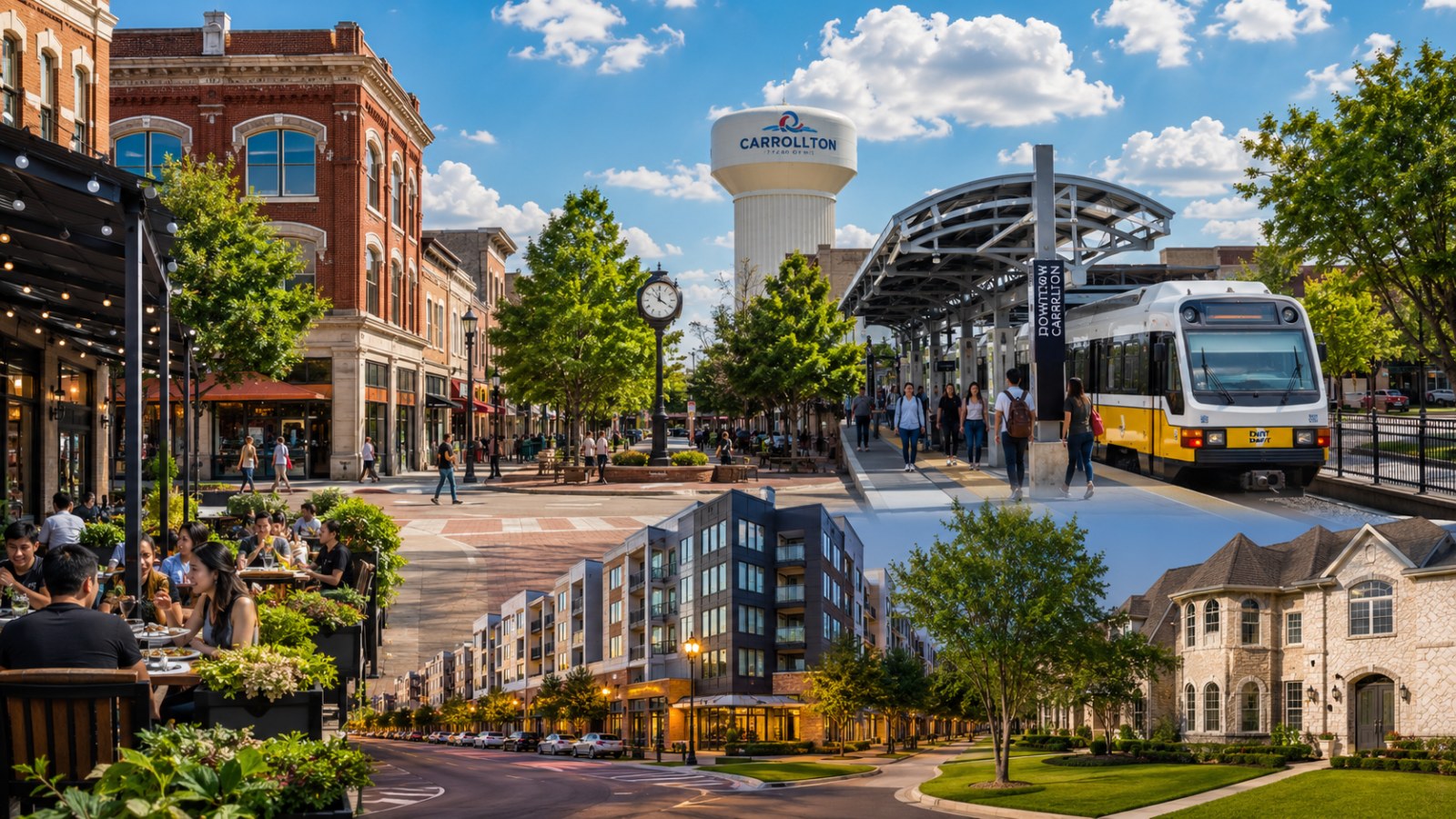
DFW at a glance
| Category | Regional consideration |
|---|---|
| Regional scale | A 16-county North Central Texas region centered on Dallas and Fort Worth |
| Housing choices | Urban condominiums, historic homes, established suburbs, new master-planned communities, custom homes, townhomes, lake-area properties, larger lots, and acreage |
| Transportation | Interstate highways, tollways, local roads, DART, Trinity Metro, DCTA, regional rail, and smaller local transit providers |
| School assignment | Determined by district boundaries and the exact property—not city or ZIP code alone |
| County jurisdiction | Many cities cross county lines |
| Growth pattern | Established urban and suburban areas coexist with rapidly developing outer communities |
| Important tradeoffs | Travel time, tolls, property age, lot size, maintenance, taxes, special districts, utilities, school boundaries, and future development |
The region’s transportation network includes three major transit authorities—DART, Trinity Metro, and the Denton County Transportation Authority—along with smaller providers. Transit access varies considerably by community and address.
Start with your actual priorities
Before selecting a city, consider:
Where do you travel regularly?
Work is only one destination. Include:
- Schools or universities
- Airports
- Medical care
- Relatives
- Recurring appointments
- Places of worship
- Recreation
- Weekend destinations
What type of home do you want?
- Detached home
- Townhome
- Condominium
- Patio home
- Urban residence
- Custom home
- New construction
- Established home
- Larger-lot or acreage property
- Waterfront or lake-area home
How much maintenance do you want?
A larger lot, pool, custom home, older property, condominium, and new subdivision each create different maintenance and ownership obligations.
How much future change is acceptable?
Some buyers prefer fully established surroundings. Others are comfortable with ongoing construction, new roads, future commercial sites, and developing amenities.
Which property-specific obligations matter?
- Property taxes
- MUD taxes
- PID assessments
- HOA or condominium dues
- Toll-road costs
- Utility providers
- Septic or sewer service
- Private-road maintenance
- Waterfront or shoreline obligations
Explore DFW communities by region
These groupings are practical navigation categories, not official governmental boundaries.
North and northwest DFW
Communities in this part of the region can offer established suburban neighborhoods, extensive new construction, mixed-use districts, townhomes, custom properties, and access to US 75, the Dallas North Tollway, SH 121, I-35E, and US 380-area corridors.
Communities to explore:
Allen • McKinney • Prosper • Celina • Little Elm • The Colony • Lewisville • Flower Mound • Denton • Corinth • Lake Dallas • Argyle • Aubrey • Pilot Point
North-central and close-in communities
These locations may appeal to buyers balancing access to Dallas, Plano, Richardson, Las Colinas, Addison, DFW Airport, or other central employment and travel destinations.
Communities to explore:
Addison • Farmers Branch • Coppell • Richardson • Carrollton • Garland • Sachse • Murphy • Wylie • Rowlett
East and northeast DFW
East DFW includes established communities, lake-oriented areas, new master-planned development, rapidly growing US 80 and I-30 corridors, and selected larger-lot or rural-edge properties.
Communities to explore:
Forney • Mesquite • Sunnyvale • Terrell • Crandall • Kaufman • Caddo Mills • Greenville • Lavon • Josephine • Princeton • Fate • Rockwall • Heath • Royse City
Dallas and close-in communities
This group includes urban housing, historic neighborhoods, established detached homes, townhomes, condominiums, redevelopment, and locations near major employment, cultural, medical, and transportation destinations.
Communities to explore:
Dallas • Highland Park • University Park • Irving • Grand Prairie • Balch Springs
Mid-Cities and airport-area communities
These communities can be useful when access to both Dallas and Fort Worth, DFW Airport, Las Colinas, or the regional highway system matters.
Communities to explore:
Grapevine • Southlake • Colleyville • Euless • Bedford • Hurst • North Richland Hills • Keller • Roanoke • Trophy Club • Westlake • Coppell • Irving
Fort Worth and west DFW
West DFW includes urban Fort Worth neighborhoods, established suburbs, newer communities, acreage and larger-lot opportunities, and locations oriented toward Tarrant or Parker County destinations.
Communities to explore:
Fort Worth • Arlington • Mansfield • Burleson • Benbrook • Aledo • Weatherford • Azle • Saginaw • Haslet • Willow Park
South and southwest DFW
This area contains established suburbs, newer residential development, larger properties in selected locations, historic downtowns, and access toward Dallas, Fort Worth, Ellis County, and the southern employment corridors.
Communities to explore:
Cedar Hill • DeSoto • Duncanville • Lancaster • Midlothian • Waxahachie • Red Oak • Ovilla • Glenn Heights • Ferris
Established neighborhoods
Start with communities that offer substantial existing housing inventory and developed roads, parks, shopping, and public services.
New construction
Search active new-home communities, but compare builders, phases, taxes, MUDs, PIDs, HOAs, roads, school rezoning, and the status of proposed amenities.
Townhomes and condominiums
Focus on areas with attached housing, mixed-use development, transit access, or lower-maintenance ownership options.
Larger lots and acreage
Search by explicit lot-size criteria rather than broad city labels. Verify utilities, septic, roads, restrictions, floodplain, maintenance, and future development.
Lake-area homes
Compare Lake Ray Hubbard, Lewisville Lake, Grapevine Lake, Lake Lavon, and other lake-oriented locations while distinguishing among waterfront, water view, public access, and simple proximity.
Rail-accessible communities
Use DART, Trinity Metro, DCTA, TRE, TEXRail, and Silver Line information to determine whether rail actually connects the property to the buyer’s destination. NCTCOG provides regional transportation and public-transit service-area maps.
A useful community comparison
Compare communities using neutral, property-relevant information:
| Comparison category | What to show |
|---|---|
| Regional location | North, east, central, west, or south DFW |
| Primary access | Highways, tollways, rail, and major local roads |
| Housing pattern | Established, mixed, largely newer, attached, urban, custom, or lake-oriented |
| New construction | Limited, selected, moderate, or substantial current availability |
| Lot patterns | Compact, conventional suburban, larger-lot, or acreage opportunities |
| Attached housing | General availability of townhomes and condominiums |
| Transit | Actual nearby service and stations |
| County variation | Whether the city crosses county lines |
| School verification | Districts that may apply and official locator links |
| Special considerations | MUDs, PIDs, lake rights, septic, redevelopment, toll dependence, or active construction |
| Full guide | Link to detailed Savage Realty community content |
| Live search | IDX results already filtered to the selected community |
Savage Realty does not assign “livability,” “safety,” “school quality,” or lifestyle scores, rank communities, or suggest who belongs in a location.
Regional transportation resources
The DFW region does not have one uniform transportation system. A buyer may need to compare:
- DART
- Trinity Metro
- DCTA
- Trinity Railway Express
- TEXRail
- DART Silver Line
- STAR Transit
- Other municipal or county providers
- Tollways and managed lanes
- Local highway and road construction
NCTCOG maintains regional transportation maps, public-transportation service areas, trail information, and other planning resources.
Test exact addresses and actual travel times instead of relying on broad commute claims.
A city name does not determine the school district.
School-district lines frequently cross city, ZIP-code, subdivision, and county boundaries. TEA notes that some newer subdivisions are split among multiple districts and that its maps should be followed by direct district verification.
For every property:
- Use the TEA School District Locator.
- Identify the district.
- Open the district’s current attendance-zone or school-choice tool.
- Confirm the campus directly with the district.
- Recheck when rezoning is under consideration.
Search by city
Visitors select one or more city names and receive IDX results already limited to those places.
Search by property priority
Visitors can combine filters such as:
- Detached home
- Townhome or condominium
- New construction
- Larger lot
- Pool
- Single-story
- Waterfront
- Open house
- Price range
- Bedroom count
A regional button should not simply open the completely unfiltered MLS page.
Useful regional links
- North Central Texas Council of Governments — regional planning and data.
- NCTCOG Population Estimates — current city and county estimates.
- NCTCOG Transportation Maps — roads, transit, trails, and planning layers.
- North Texas Transit Providers — DART, Trinity Metro, DCTA, and other services.
- Texas Education Agency District Locator — general district-boundary research.
Published Savage Realty Guides
Explore complete DFW community guides.
Allen
An established Collin County community with varied housing, extensive trails, major shopping and employment destinations, and access to US 75 and SH 121.
Carrollton
Established neighborhoods, varied home types, regional rail, and access to I-35E, the Bush Turnpike, and SH 121.
Dallas
Distinct neighborhoods, urban and suburban housing, established homes, newer infill, and access choices that vary significantly by location.
Fate
A growing Rockwall County community with substantial newer-home options, developing local amenities, and access to the I-30 corridor.
Forney
A growing Kaufman County community with substantial new construction, established neighborhoods, and access along the US 80 corridor.
Frisco
A large north DFW community with established neighborhoods, extensive newer housing, mixed-use districts, and continuing development.
Garland
An established northeast DFW city with broad housing choices, DART rail, major parks and trails, and access to Lake Ray Hubbard.
Heath
A lower-density Lake Ray Hubbard community with custom homes, larger-lot options, and waterfront or lake-area properties.
McKinney
A large Collin County community with historic neighborhoods, established housing, substantial newer development, and access to US 75, SH 121, and US 380.
Mesquite
An established east DFW city with broad housing choices, major new development, parks, trails, and regional highway access.
Plano
An established north DFW community with varied housing, extensive parks and trails, major employment districts, and regional rail access.
Prosper
A growing north DFW community with substantial new construction, custom homes, larger-lot options, and access to the Dallas North Tollway and US 380.
Richardson
An established north-central DFW community with varied housing, major employment districts, and regional rail connections.
Rockwall
Established and newer neighborhoods, a historic downtown, Lake Ray Hubbard access, and connections along the I-30 corridor.
Rowlett
An established lakeside community with DART Blue Line service, varied housing, Lake Ray Hubbard access, and connections to Garland, Rockwall, and Dallas.
Royse City
A growing east DFW community with substantial new construction, established neighborhoods, and a historic Main Street district.
Sachse
An established and growing northeast DFW community with newer development and access to SH 78 and the Bush Turnpike.
Current Listings
Search homes across the DFW Metroplex.
Browse the approved public Matrix search, or ask our team to build a focused search around the communities and property priorities that matter to you.
Frequently Asked Questions
Questions about Other DFW Communities
How many communities are in the DFW area?
There is no single short list. NCTCOG’s 16-county region includes more than 230 member governments and numerous cities, districts, and special-purpose entities.
Can Savage Realty compare communities on both the Dallas and Fort Worth sides?
Yes. The comparison should begin with the buyer’s destinations, property needs, and travel pattern rather than an arbitrary east-versus-west division.
Can I search based on commute instead of city?
Yes. The search-planning process should start with exact destinations and realistic weekday travel times, then identify communities that fit the route.
Why can’t I rely on the city name for schools?
School-district boundaries often do not match municipal or ZIP-code boundaries. TEA recommends verifying the district and then contacting the local district for campus information.
Will every DFW city receive a full guide?
The most relevant communities can receive complete guides first. Every directory entry should still provide accurate basic information, official resources, a city-filtered home search, and a way to request a comparison.
Does every DFW community have public transportation?
No. Transit systems, service levels, station access, operating hours, and coverage vary substantially across the region.
DFW COMMUNITY SEARCH
Build a home search around the way you actually expect to live.
Tell us where you need to travel, what type of home you prefer, your budget, lot-size needs, construction preference, and how much maintenance or future development you are comfortable with. The Savage Realty team will help you compare realistic communities before building the live home search.