Savage Realty Guide
DFW Relocation Checklist
An objective planning guide for work location, travel, housing, costs, visits, financing, inspections, closing, and move-in across Dallas–Fort Worth.
Plan a Relocation Search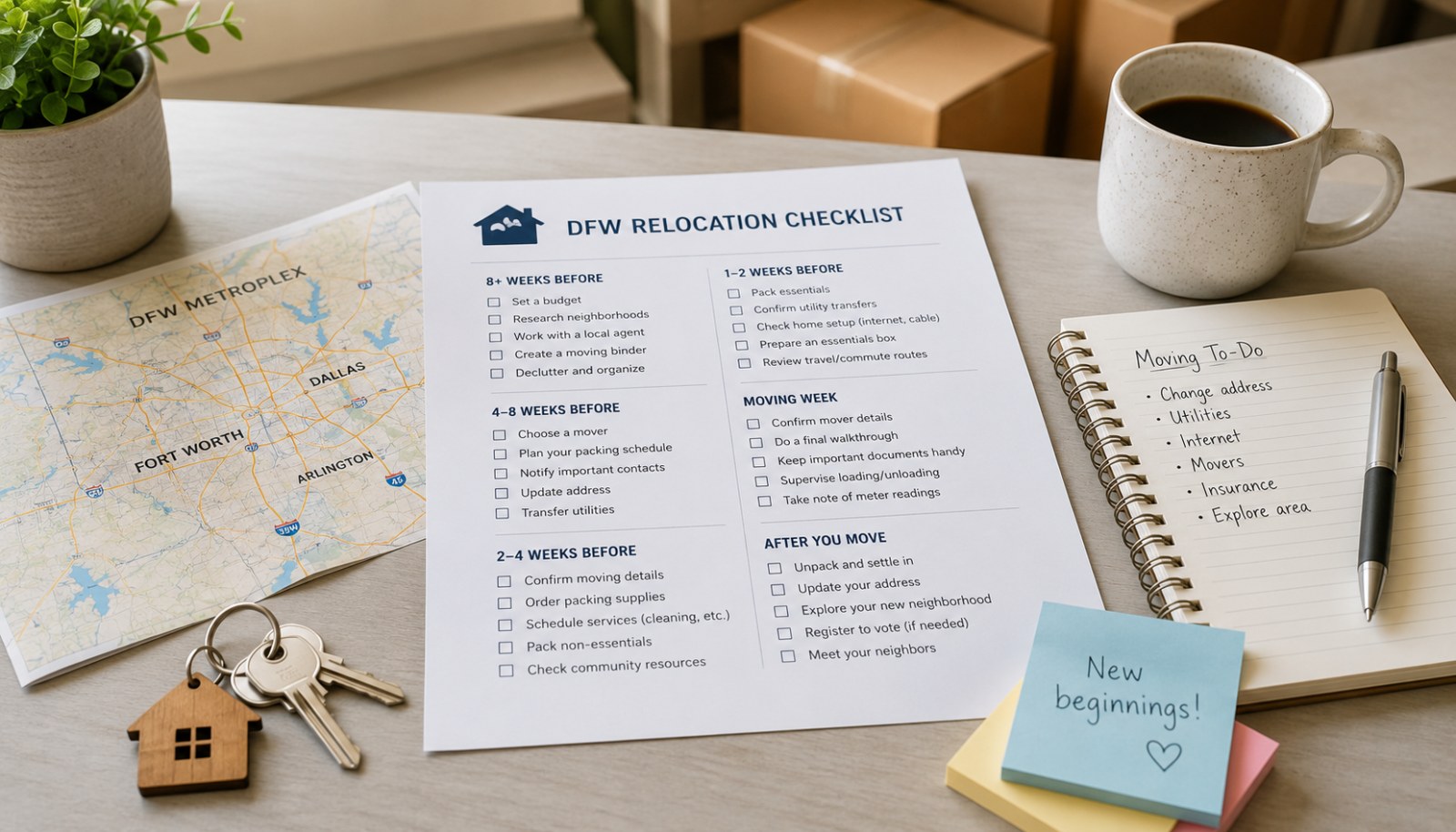
What This Guide Covers
- Location and travel
- Housing and budget
- Area visits and remote search
- Contract and insurance
- Move logistics
Map work and travel needs
Start with the trips that shape an ordinary week.
- Record work locations, expected office schedule, commute tolerance, toll-road preferences, airports, family, medical care, transit when relevant, recurring school or activity routes, and weekend travel.
- Test routes on the actual days and times you expect to travel rather than relying on mileage or an unsupported commute guarantee.
- Compare toll-road alternatives and recurring toll costs with the official NTTA Toll Calculator.
Define housing and cost priorities
Compare the complete ownership picture.
- Set home type, size, lot, age, condition, new-construction interest, budget, property-tax range, association considerations, and maintenance tolerance.
- Estimate property taxes using projected taxable or appraised value, applicable taxing entities, and the buyer’s eligibility for exemptions—not only the seller’s current tax bill.
- Account for HOA dues, PID assessments, MUD taxes or fees where applicable, and other special assessments.
- Identify daily priorities such as shopping, recreation, medical access, family logistics, and the amount of driving they may require.
- Verify school boundaries directly with the appropriate source when relevant; do not use rankings or demographic assumptions as a substitute for the client’s own criteria.
Plan visits and remote review
Use each visit to answer specific questions.
- Organize area orientation, representative home tours, route checks, and time for second looks.
- Use remote consultations, OneHome, listing review, live video tours, street context, and map review between visits.
- Consider temporary housing if employment, sale, lease, construction, or closing dates do not align.
Coordinate purchase and protection
Remote transactions still require complete due diligence.
- Prepare financing, earnest money and option delivery, inspections, specialist review, appraisal, title, survey, insurance, and closing logistics.
- Verify foundation condition, grading, drainage, flood exposure, pool condition, utilities, and property-specific maintenance rather than making assumptions about an entire city or neighborhood.
- Ask about roof age and condition, claim history, open claims, unresolved claim work, replacement-cost versus actual-cash-value roof coverage, wind and hail deductibles, and insurance availability before the option period expires.
Use official verification sources
Property-specific records are more useful than general assumptions.
- Confirm tax estimates and exemptions with the Texas Comptroller and the applicable local appraisal districts.
- Use Texas Department of Insurance consumer guidance and property-specific insurance quotes for coverage questions.
- Use official school-district boundary tools when school boundaries are part of the search criteria.
Prepare the move and first week
Schedule logistics before closing becomes urgent.
- Coordinate the originating sale or lease, moving company, vehicles, pets, utilities, secure document handling, address changes, access, and first-week essentials.
- Keep identity documents, medications, chargers, basic tools, closing records, insurance, and immediate property contacts accessible.
Action Checklist
- Map work and recurring trips
- Set commute and toll preferences
- Define home and lot type
- Model taxes, insurance, HOA, and maintenance
- Plan area visits
- Verify school boundaries objectively when relevant
- Set remote-tour process
- Coordinate originating sale or lease
- Prepare financing and inspections
- Confirm insurance
- Schedule movers and utilities
- Prepare first-week essentials
Common Mistakes to Avoid
- Choosing by city name alone
- Assuming distance equals travel time
- Ignoring property taxes, tolls, insurance, or association costs
- Relying on school rankings or neighborhood stereotypes
- Waiting until closing week to coordinate moving and utilities
Questions to Ask
- Which weekly trips matter most?
- What housing tradeoffs are acceptable?
- Which costs vary meaningfully by property or location?
- What must be seen in person?
- How will timing gaps be handled?
This guide provides general educational information and is not individualized legal, tax, lending, insurance, inspection, engineering, appraisal, or investment advice. Contract documents, current law, lender requirements, title documents, and property-specific professional evaluations control.
Last reviewed: July 2026
Ready to Discuss Your Situation?
Use this guide to prepare your questions, then contact our team for guidance tailored to the property and decision in front of you.
Plan a Relocation Search Contact Our Team